Render repair in Hucknall
Render repair in Hucknall
A local repair should have a reason, a boundary and a compatible method. A cracked gable or damaged area around a door does not automatically require replacing the whole house, but a patch should not leave the cause untouched. Start with an inspection that distinguishes the visible defect from the condition of the surrounding finish.

On this page
Locate the problem on the building
Photograph the full wall and then the affected area from a safe position. Include fixed features so the surveyor can locate the defect. Note when it appeared and any relevant change, such as a leak, new opening or impact. Those observations are useful background; they should not be presented as a confirmed explanation without assessment.
Describe cracks, staining, detachment and broken edges separately. A dark mark is not necessarily failed render, and a fine visible crack does not establish how far the defect extends. The inspection needs to consider the material, adhesion and relevant adjoining details. Where upper areas cannot be reached, record that limit instead of assuming they are sound.
If loose material threatens an entrance or route, arrange a competent assessment and appropriate precautions. Avoid pulling at it or trying to test the whole wall from improvised access. The repair scope can be agreed once the condition and access needs are understood. An urgent safety concern and the final decorative treatment may require different stages.
| Record | Useful detail |
|---|---|
| Location | Elevation and nearby fixed feature |
| Assessment | Material, condition and likely cause |
| Boundary | Sound edge and retained adjacent work |
| Method | Compatible repair and associated corrections |
| Appearance | Sample and agreed matching limits |
| Handover | Before, opened and completed photographs |
- Map the damage Tapping finds hollow areas; cracks and their likely cause are noted.
- Cut back Failed render is cut out to a sound edge, usually squared off.
- Fix the cause Leaking gutters, sills without drips or render below the DPC are dealt with.
- Rebuild in coats Using a material compatible with the surrounding render and masonry.
- Blend the finish Texture is matched; colour may need a coating over the wider area.
The usual order of work. The survey and the chosen products decide the actual steps.
Identify what must change beyond the patch
Repeated damage below a downpipe or sill may need correction to the water detail. Record that work separately and assign it to the responsible trade. Filling the damaged surface without addressing continued wetting can leave the new repair exposed to the same cause. The finish is one part of the completed solution, not a substitute for functioning roof-water arrangements.
Cracks at changes in construction need an assessment of movement and the relevant design. A required joint should not be filled rigidly simply to remove a visible line. Reinforcement may form part of an appropriate system detail, but it is not a universal answer to every moving interface. Seek the relevant advice if the cause is uncertain or extends beyond surface work.
Damage to external wall insulation needs identification of the affected layers. The visible hole may extend into insulation, reinforcement or a weathering junction. A repair should follow the supported system method and restore those elements appropriately. Treating every rendered wall as a thin layer over masonry can lead to the wrong scope and materials.
Choose a boundary that leaves sound work
The repair outline should reflect the condition of the finish and the chosen method. A small neat rectangle around the visible mark may leave unsound material immediately outside it. Ask how the extent will be confirmed during opening up and how a changed area is agreed. Keep photographs of the revealed edge and background before rebuilding.
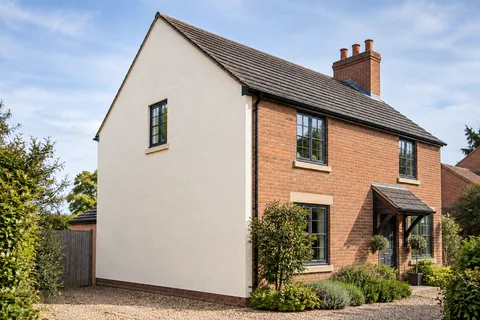
On a gable beside a sound frontage, protection and the corner detail matter. Decide whether the repair stays within the gable or returns around the corner. The retained finish should not be damaged in an attempt to make the new patch easier to form. Show the boundary on the survey photographs so the contractor and owner share the same expectation.
Wall rendering may be the more appropriate scope if defects cover a substantial area or the retained material is unsuitable. Compare that with local repair using the same inspection findings. A larger proposal should explain why replacement is needed, while a smaller one should explain why the remaining work can safely and compatibly stay.
Match the material before matching the colour
The repair material needs to suit the existing system and substrate. An old lime-finished wall should not automatically receive a dense generic patching mix. Lime rendering guidance helps explain why compatibility is relevant, while the actual specification should follow the assessment. Modern systems likewise need a supported repair method rather than a product chosen solely because it is on the van.
Record the preparation, layer sequence and relevant curing requirements. A repair may look finished before it is ready for a coating or final inspection. The programme should allow the material to reach the specified condition. If another trade needs to work nearby, protect the repair and coordinate the timing instead of treating it as immediately ready for every subsequent operation.
If the original system cannot be identified, state that uncertainty and obtain appropriate advice. A colour sample does not determine material compatibility. Keep any findings, test records and selected product references with the quotation. They provide a clearer explanation of the method than a general assurance that the patch will be similar to what is already there.
Agree how much visual difference is acceptable
Weathering, texture and previous coatings can make a repair visible even when the material is compatible. Discuss the expected result before approving a small patch on a prominent area. A cured trial can show what is realistic. Avoid relying on a promise of an invisible repair under every light condition or after different parts have weathered for different lengths of time.
A compatible coating across a complete panel may be an option after repair. Render respray can improve colour consistency where the existing surface and preparation support it, but it may not hide changes in texture. Compare a sample that includes the repaired area rather than approving only a clean patch of the old finish.
If a new texture is wanted across the elevation, the project may move beyond repair into a new specified finish. Silicone rendering is one option to compare on a suitable supported build-up. Keep the change of scope clear, including any further preparation, edges and sample approval. A local repair quotation should not quietly become a different system without agreement.
Keep a useful repair history
At completion, record the exact area, materials and associated repairs to fittings or junctions. Include photographs before work, while opened and after finishing. If a defect recurs, that sequence helps establish whether it is in the same location and what was previously investigated. It is more useful than an invoice that simply says repair outside wall.
Follow the relevant care guidance and inspect adjoining rainwater details. If a new mark appears, compare it with the repair record before choosing a cleaning or coating treatment. The purpose of retaining evidence is practical: a future contractor can identify the construction and previous scope without reopening sound work solely to find out what was used.
Common questions
Can a gable repair leave the frontage untouched?
That can be the intended scope, with an appropriate corner detail and protection. Survey the adjoining condition and mark the exact boundary before work. A limited repair still needs suitable access and a matching agreement, so keeping the frontage does not mean its relationship with the repaired wall can be ignored.
See housing and planning information for Hucknall and nearby places, including the source and geography behind each figure.